What future bridges demand: lessons from the Saale Valley Crossing
|
Insights
The requirements placed on bridge structures are constantly evolving: alongside safety and durability, design quality and environmental responsibility are now equally important. The Saale Valley Crossing near Bad Kösen demonstrates how KREBS+KIEFER, as part of Dorsch Europe, combines innovative engineering, sustainable construction methods and digital planning into a forward-looking whole. The project sets new benchmarks for modern infrastructure and shows how technical excellence and societal value go hand in hand.
Transport infrastructure for the future: the Saale Valley Crossing as a benchmark for resilient bridge engineering
Germany faces the central task of modernising its transport infrastructure and securing it for future generations. Bridges form the backbone of the mobility network: they connect regions, safeguard supply and enable sustainable development. Yet many existing structures are reaching their load limits. New structures must not only be technically convincing but also set standards in design and environmental terms.
The Saale Valley Crossing, built as part of the new Bad Kösen bypass, is a prime example of the future of bridge engineering. The project shows how interdisciplinary teams, modern construction methods and digital tools such as Building Information Modelling (BIM) master complex challenges and make investment in sustainable mobility effective.
A seamless hybrid structure – a rarity in major bridge engineering
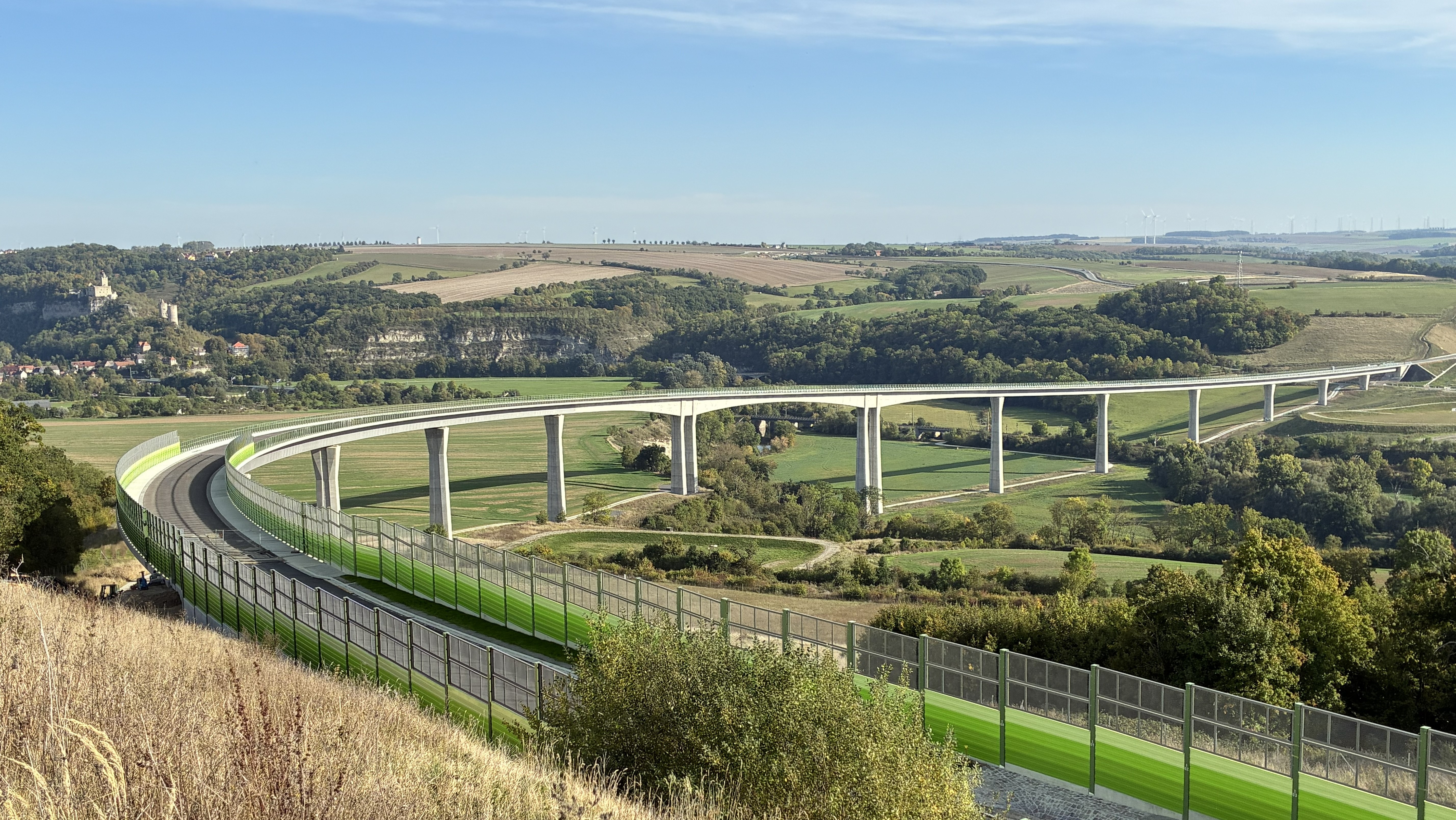
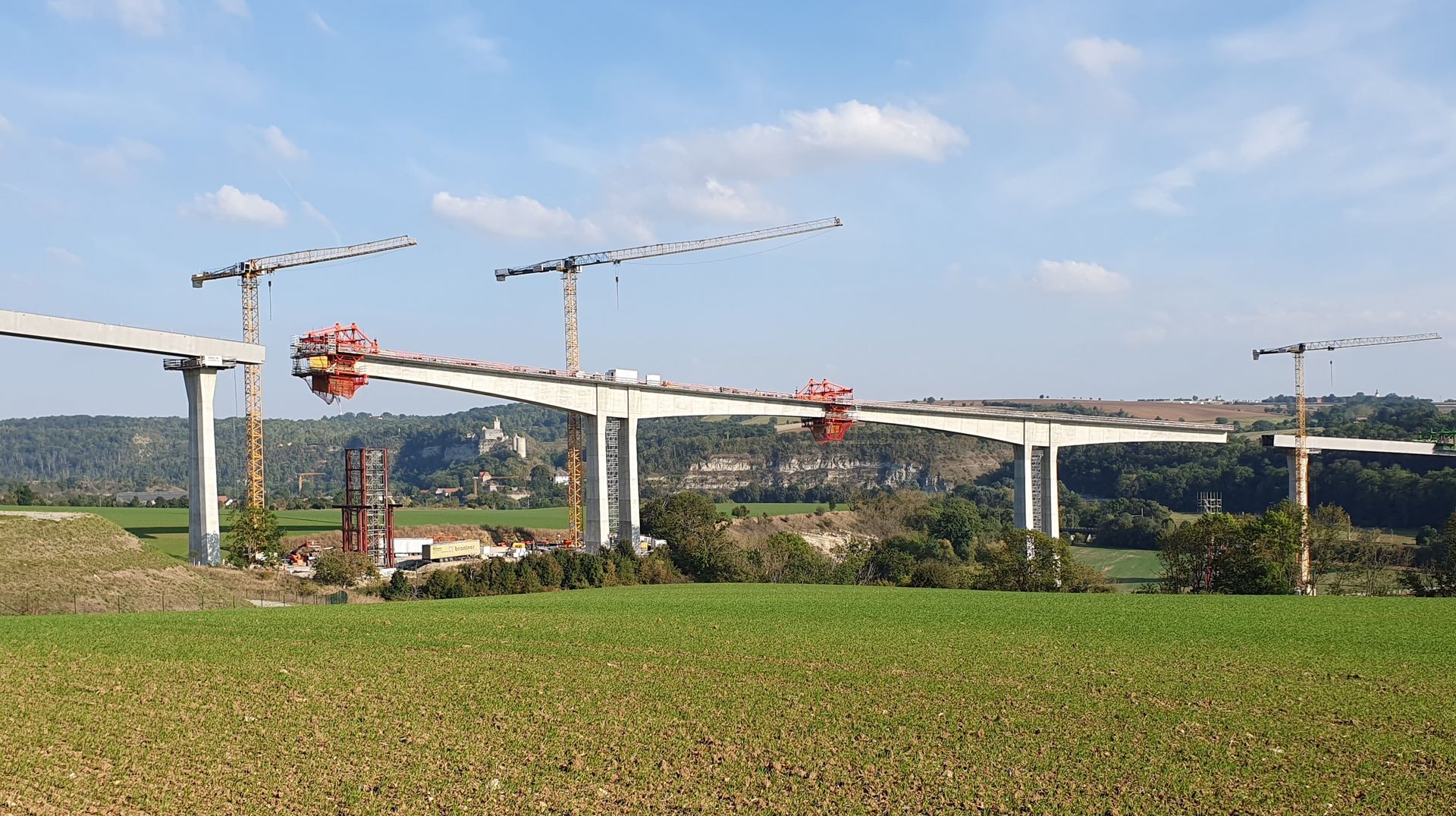
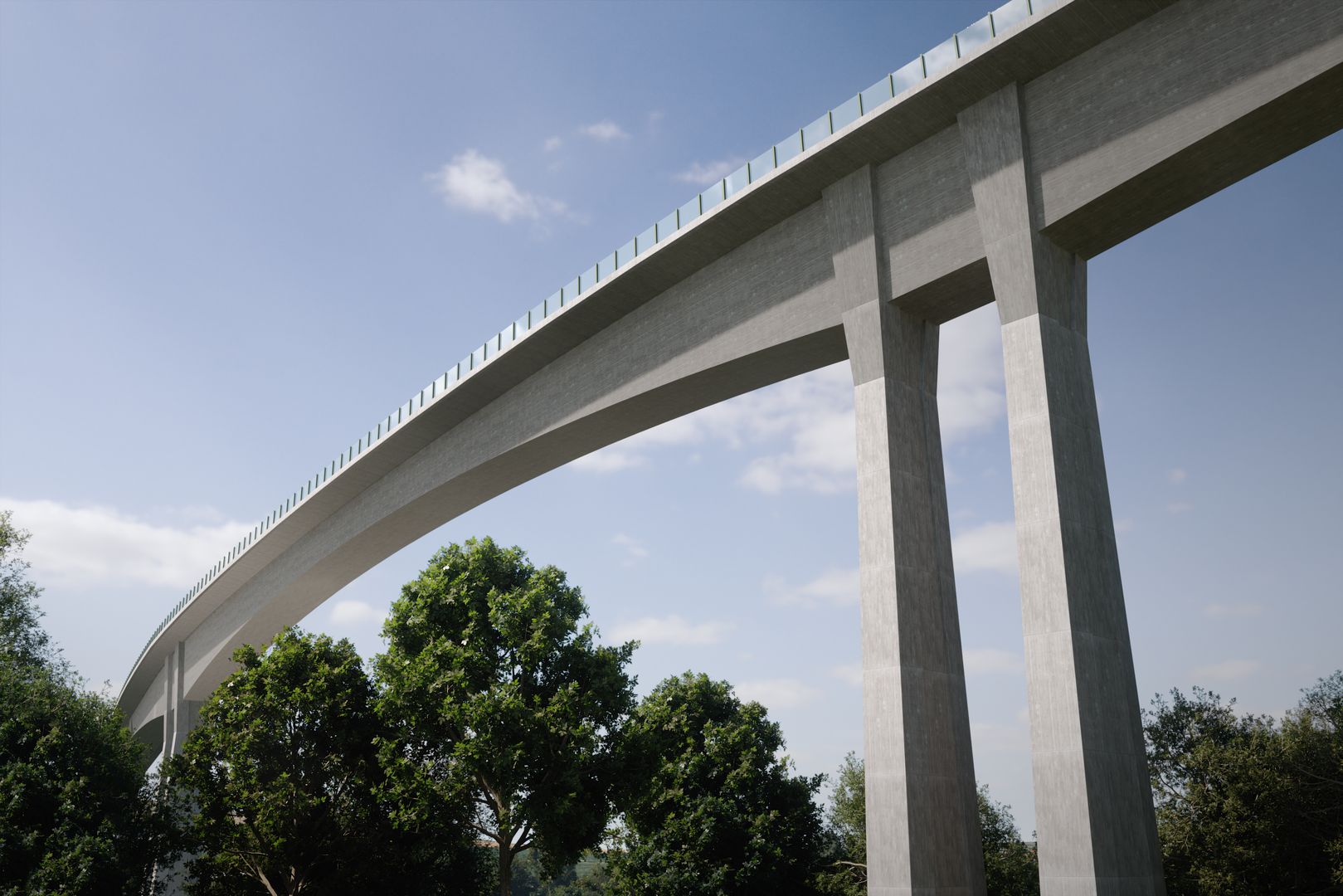
The Saale Valley Crossing extends over 1,226 metres and reaches heights of up to 65 metres. It combines two fundamentally different construction principles: a parabolically haunched prestressed concrete box girder in the central section, built using the balanced cantilever method, and the northern and southern ramp sections, realised as steel composite superstructures using the incremental launching method. Once the three superstructure sections were completed, they were joined monolithically at two hybrid connection points. The result is a continuous, seamless hybrid superstructure – a rarity in major bridge engineering. This exceptional construction method placed the highest demands on planning, logistics and execution. Integrating both construction methods into a single monolithic structure required precise coordination and innovative detail solutions – from the exact alignment of the individual construction sections at a height of more than 50 metres to the aerodynamic stabilisation of the steel composite superstructures during launching, achieved with special attachments tested in a wind tunnel.
A model for resilient, future-proof infrastructure
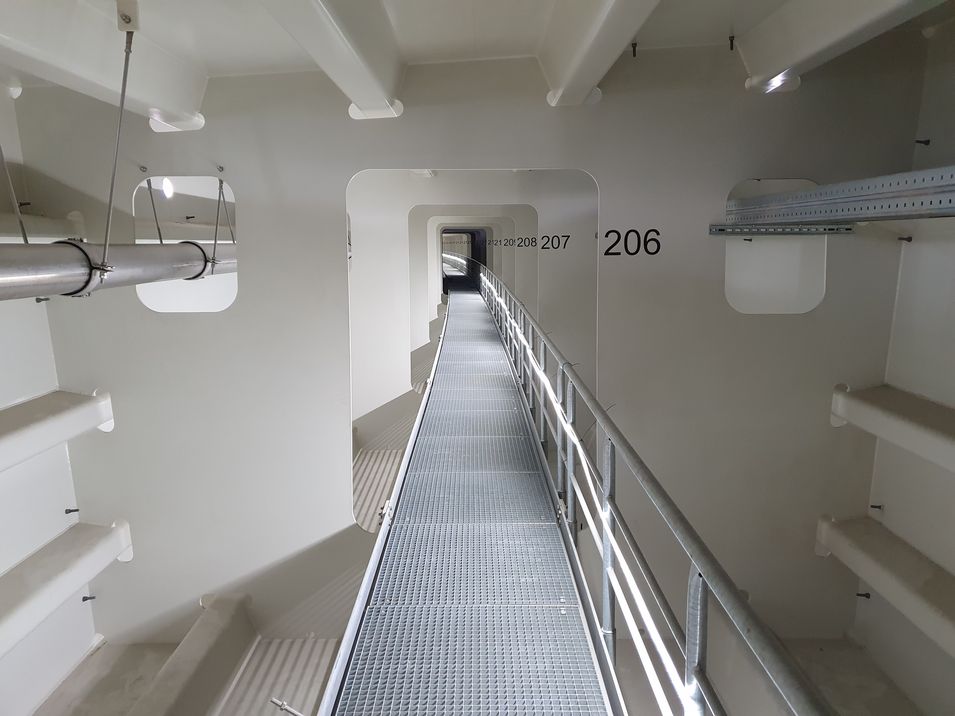
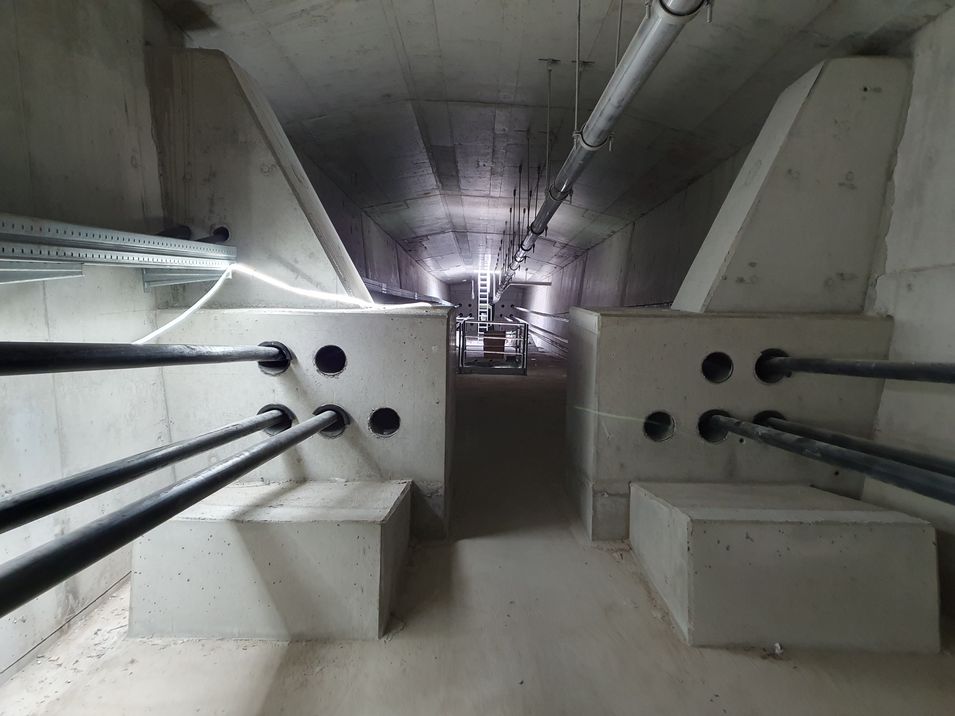
The Saale Valley Crossing proves that sustainable infrastructure need not compromise on functionality or design. The engineering teams at KREBS+KIEFER relied on resource-efficient construction methods and minimised interventions in the sensitive natural environment of the Saale valley. The hybrid structure required no temporary falsework within the nature reserve, reducing both material use and construction time. The bridge deck is fully accessible and inspectable from the inside. Should traffic loads increase further in future, the bridge's load-bearing capacity can be increased, if required, by retrofitting additional external tendons within the box girder.
Deliberately avoiding extreme component slenderness, the engineers created a robust and durable structure instead. Every component was shaped consistently in line with the flow of forces, with dimensions carefully matched to the respective loads and optimised for cost-effectiveness. Digital methods such as Building Information Modelling (BIM) enabled precise planning, clash detection and efficient public communication through the use of photorealistic visualisations during the planning phase.
As the structure attracted considerable public attention during planning and was also critically questioned because of its prominent location in the Saale valley, high-quality visualisation was important for presenting the project positively to the public. This digital capability accelerated implementation and improved the quality of execution. The bridge is thus a model of resilient, future-proof infrastructure that can adapt to changing demands and climate conditions.
“As the structure attracted considerable public attention during the planning phase and was also critically questioned because of its prominent location in the Saale valley, high-quality visualisation of the structure was important for presenting it positively to the public.”
In 2025, the German Federal Association of Road and Transport Engineers (Bundesvereinigung der Straßenbau- und Verkehrsingenieure, BSVI) awarded the Saale Valley Crossing second place in the German Engineering Award for Roads and Transport (Deutscher Ingenieurpreis Straße und Verkehr), in the ‘Building Culture’ category. The jury honoured the combination of technical excellence, sustainable construction and design sensitivity. According to the jury, the slender, articulated piers and the harmonious integration into the landscape set particular new benchmarks. This award underlines the societal relevance of modern infrastructure, showing how engineering can advance quality of life, mobility and climate protection in equal measure.
The Saale Valley Crossing: a model for sustainable infrastructure
The Saale Valley Crossing exemplifies the development of high-performance, sustainable transport infrastructure in Germany. With its holistic planning approach, the project demonstrates how innovative hybrid construction, consistent digitalisation and design sensitivity produce bridge structures that go far beyond pure functionality. Its integration into the sensitive Saale valley shows that sophisticated engineering and landscape integration are not mutually exclusive. Dorsch Europe brings together interdisciplinary expertise for this purpose – from planning through construction to on-site quality assurance. The result is a structure that combines technical excellence with societal and environmental value, setting benchmarks for future infrastructure projects.
Hybrid construction of the Saale Valley Crossing
North steel composite superstructure: 448 metres long; spans ranging from 40 to 92 metres; built using the incremental launching method (launched downhill on a curve with a 6% gradient)
Prestressed concrete superstructure: 320 metres long; spans ranging from 95 to 130 metres; built using the balanced cantilever method (main span) and with temporary falsework (side spans)
South steel composite superstructure: 458 metres long; spans ranging from 45 to 94 metres; built using the incremental launching method (launched uphill with a gradient of up to 6%)
Hybrid connections: monolithic joints between the steel composite and prestressed concrete superstructures forming a seamless, 1,226-metre-long bridge deck; force transfer via shear studs and tendons
Technical and design features of the structure
All 16 piers of the valley bridge share an identical geometry, giving the structure a calm, coherent appearance despite its scale.
The abutments and piers are founded on large-diameter bored piles up to 34 metres long, anchored in bedrock. Expected settlement amounts to only a few millimetres.
The twin piers are connected to the prestressed concrete superstructure integrally (without bearings). Owing to their slender dimensions, the piers can readily accommodate the superstructure's thermal movements.